Compare Alternatives Before You Choose


You know the feature you want, but not yet which direction should become the product.
That is the moment where AI is most tempting and most dangerous: it can build a plausible version fast, but a plausible version can quietly become the direction before you have compared the alternatives.
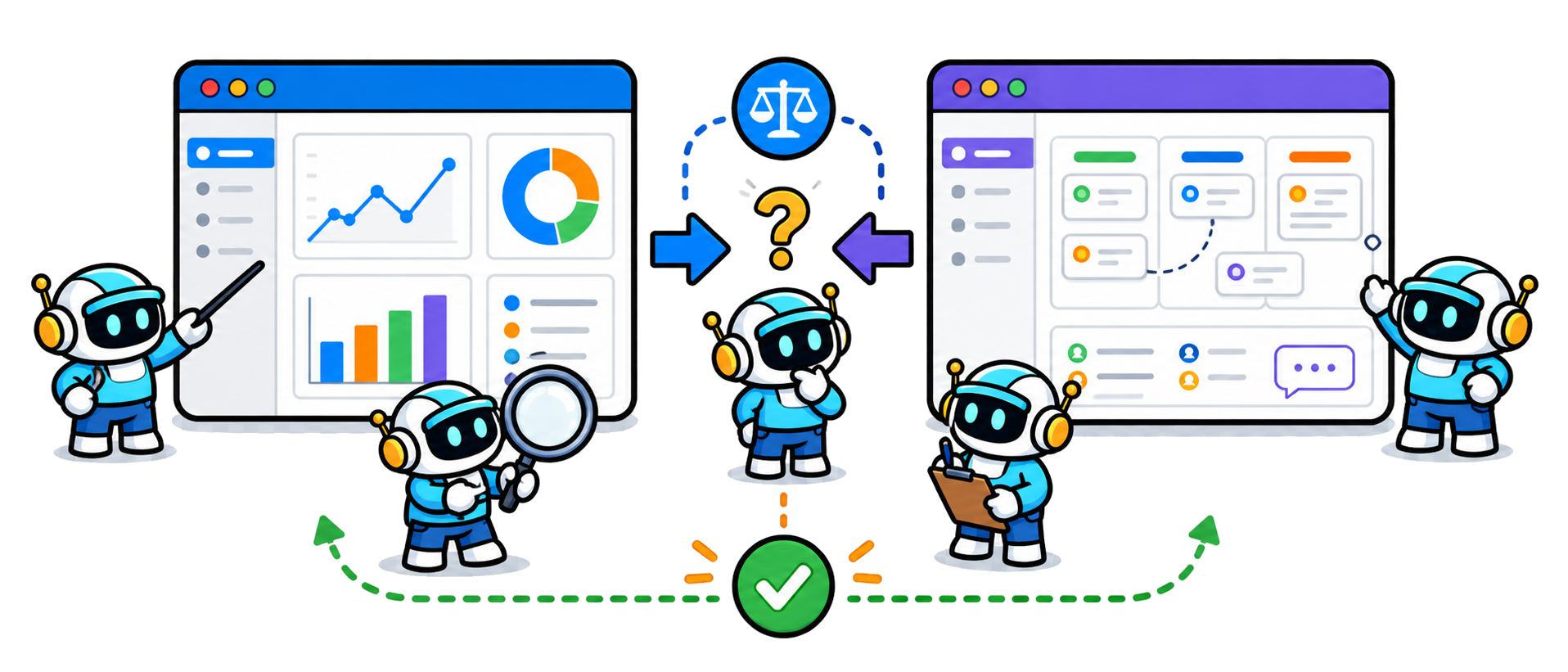
Imagine you are changing account recovery.
There are several reasonable directions:
- keep password reset email-only
- add SMS as a second recovery path
- build a separate admin-assisted recovery flow
- try an experimental reset-token storage model
Each option sounds small in a prompt. Each option changes something real for the user: security expectations, support workload, privacy exposure, implementation complexity, verification needs, and what failure modes the product must handle.
This is why comparison matters.
The question is not:
Can the agent build one of these?
The better question is:
Which direction should we choose, and what does each direction really imply?
What Usually Goes Wrong
In ordinary AI-assisted development, the comparison often collapses too early.
You ask for SMS recovery. The agent finds email recovery. It edits nearby code. It invents a reasonable policy. It updates tests. The result may even run.
But now several things are mixed together:
- existing product behavior
- the new alternative
- implementation guesses
- security assumptions
- test changes
- the agent's interpretation of your intent
At review time, you are no longer comparing clean options. You are trying to reverse-engineer what the agent changed and which parts of the change were product decisions.
That is expensive for the developer and risky for the user.
What Changes For The Developer
With FST, comparing alternatives becomes a first-class workflow instead of a prompt trick.
The developer can say:
Compare email-only reset, email plus SMS reset, and admin-assisted reset.
Do not merge them yet.
Show what each option changes and what decisions are required.
That changes the work in three useful ways.
First, alternatives stay separate while they are being understood. The agent does not have to pretend one option is already the product direction.
Second, the comparison produces decision material, not just code. You can see what each path implies before choosing.
Third, the chosen direction becomes explicit. The developer does not have to infer from the final diff which product choice was made.
The result is a cleaner development loop:
explore alternatives -> compare consequences -> choose direction -> build inside that direction
What The User Gets
The user gets a better decision surface.
Instead of reviewing a large mixed patch, they can ask:
- What changes for users in each option?
- Which policies or risks are different?
- Which implementation areas are touched?
- Which checks would be needed?
- Which option is blocked by missing decisions?
- Which option is ready to build?
This is the core benefit: the user chooses between understandable directions, not between piles of code.
How FST Makes This Work
FST starts by creating an Accepted Work Context for the comparison.
For a normal task, that context may contain one starting world. For comparison, it can deliberately include multiple possible worlds or variants:
email-only recovery
email plus SMS recovery
admin-assisted recovery
FST does not merge those worlds during context selection. It keeps their origins visible.
That matters because the agent may need to inspect all of them, but Build should not be allowed to blur them into one accidental system.
Search Without Blending
After the Accepted Work Context is selected, FST derives the search view the agent may inspect.
In comparison mode, search results preserve where they came from:
this behavior came from email-only recovery
this policy came from SMS recovery
this implementation came from admin-assisted recovery
The agent can now explore across options without treating everything it finds as compatible.
If two alternatives answer the same decision differently, FST records that as comparison evidence instead of letting one answer silently overwrite the other.
Separate Scope For Separate Options
Exploration then identifies what each alternative touches.
For SMS recovery, scope might include phone-number verification, rate limiting, message delivery, and abuse handling.
For admin-assisted recovery, scope might include admin permissions, audit logging, support workflows, and account ownership checks.
Those are not the same change. FST keeps the differences visible.
This gives the developer a practical map:
Option A touches these behaviors and checks.
Option B touches these policies and risks.
Option C needs these user decisions before Build.
Candidates Stay Comparable
If the agent builds draft work for multiple options, FST records them as separate work packages.
That means the comparison can include concrete implementation evidence without forcing an early merge.
One option may pass its checks. Another may reveal a policy conflict. A third may need user input before it can move forward.
The important part is that those outcomes stay attached to the option that produced them.
Compose Checks The Possible Worlds
When an option is ready to evaluate, FST composes the exact revisions for that option into a possible world and checks whether it holds together.
This is where FST can answer:
Does this alternative fit with the selected system?
Are required decisions unique?
Do policies still hold?
Are the right checks present?
Is user evidence sufficient?
The output is not "this is globally accepted." The output is more precise:
this option is coherent
this option is blocked
this option needs a decision
this option conflicts with policy
That is the confidence layer the user needs before choosing.
Choosing Becomes A Recorded Decision
Once the user chooses a direction, FST records that choice.
The selected option can then become the context for focused Build work. The alternatives do not disappear. They remain useful evidence:
- why one path was chosen
- what was rejected or deferred
- which risks were known
- what would need to change if the decision is revisited
This is what improves the developer's work over time. Product direction stops living only in memory, chat history, or PR comments.
The Practical Result
Comparing alternatives with FST gives the developer a way to move fast without turning exploration into accidental commitment.
The user gets a clearer choice.
The agent gets a bounded task.
The system keeps a record of what was compared, what changed, what was checked, and why one direction moved forward.
That is how AI can help with product exploration without quietly deciding the product for you.