Resume Long-Running AI Work

Some software work does not fit into one AI session.
That is normal. The problem is what happens when the next session has to continue from memory, a long chat, or a half-understood diff.
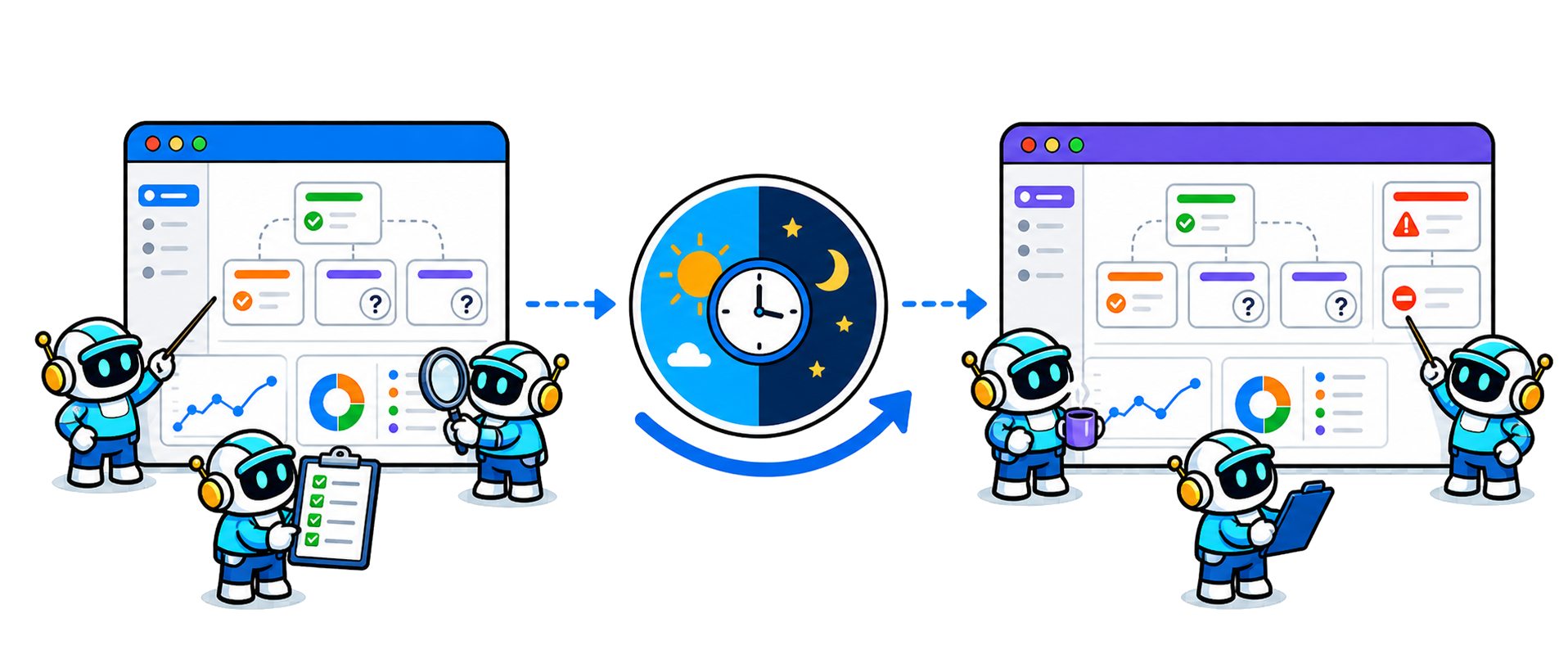
Imagine you are adding a new billing flow.
The work spans several areas:
- pricing rules
- subscription state
- payment-provider callbacks
- customer-facing emails
- admin visibility
- tests and migration behavior
The first AI session makes progress. It explores the current billing code, finds a policy issue, asks you a product decision, writes part of the implementation, and discovers that webhook handling needs a wider scope than expected.
Then the session ends.
Now the next day begins with a risky question:
Where exactly did we leave off?
Why This Matters For The User
Long-running work fails when the user has to reconstruct the state of the task.
The user should not have to remember:
- which product decision they already made
- which files were safe to touch
- which behavior was still undecided
- which check failed
- whether the agent was blocked by scope, policy, or implementation
- which parts were only explored and which parts were ready to continue
If the user has to recover all of that from chat history, the system has already lost control.
For the user, resumable work means they can come back later and ask:
What is still open?
What decision do you need from me?
What did the last run prove?
What can the next agent safely continue?
That is the benefit: continuity without replaying the whole conversation.
What Usually Goes Wrong
In ordinary AI-assisted development, resuming work often starts with a weak summary:
We were almost done.
The scope was mostly billing.
The user chose the stricter behavior.
Tests were partly passing.
Continue from the last changes.
This is not a stable handoff.
The next agent has to infer too much. It may treat an unresolved question as settled. It may continue from a temporary implementation. It may edit outside the original scope. It may rely on tests that passed against an older version of the work.
The developer then has to review not only the new work, but the continuity of the work.
That is slow and fragile.
What Changes For The Developer
With FST, the developer does not resume from a narrative. They resume from recorded work state.
Instead of asking the next agent to read a long chat, the developer can ask:
Continue the billing-flow work from the recorded context.
Show the retained scope, open blockers, recorded decisions, and last checks before building.
That changes the developer workflow in a useful way.
First, the next session starts with the same boundaries. The agent can inspect what was selected as context and what Build was allowed to touch.
Second, unresolved decisions remain unresolved. They are not converted into assumptions just because the previous session ended.
Third, failed or partial checks remain visible. The next agent knows whether it is continuing from verified work, blocked work, or temporary exploration.
The developer gets a cleaner loop:
pause -> inspect recorded state -> resolve next blocker -> continue safely
What The User Gets
The user gets fewer repeated questions and fewer hidden assumptions.
A good resumed session can say:
- you asked for this billing behavior
- this was the Accepted Work Context
- this was the scope retained for Build
- you already answered this decision
- this decision is still missing
- this check passed
- this check failed
- this scope expansion is required before work can continue
That gives the user a small set of meaningful actions instead of a large reconstruction task.
How FST Makes This Work
FST records the request as evidence, then records the Accepted Work Context.
That context matters when work resumes because it tells the next session where Exploration was allowed to look.
For the billing example, the context might include:
current subscription system
payment-provider integration
customer notification flow
It might deliberately exclude unrelated checkout experiments or old pricing variants.
When the next session starts, FST can show the context instead of asking the agent to rediscover it from the repository.
Retained Scope Survives The Pause
Exploration produces retained scope: the parts of the system Build may use or change.
That retained scope is what keeps resumption controlled.
If the previous session retained subscription state and customer emails, the next agent should not silently modify invoice exports just because the file looks nearby.
If it needs invoice exports, that is not a continuation detail. It is a scope change.
FST can block and ask for scope expansion instead of letting the resumed session drift.
Decisions Stay Attached To The Questions
Long work often contains decisions:
Should failed payments immediately suspend access?
Should the customer receive an email before suspension?
Should existing customers be migrated automatically?
FST records answers as evidence bound to the exact question.
That matters on resume because a later agent should not rely on:
The user wanted the stricter option.
It should rely on:
The user chose automatic suspension after 7 days for failed payments.
This answer satisfies the billing-suspension decision requirement.
The difference is control.
Blockers Become The Next Work Item
When a session ends blocked, the blocker should be useful.
Examples:
- retained scope is too small
- policy exception needs approval
- verification is missing
- user decision is unresolved
- materialization target needs approval
- the attempted implementation conflicts with an existing behavior
FST records blockers so the next session can start from the actual reason work stopped.
The next agent does not need to guess whether the previous run failed because of code, tests, scope, or product ambiguity.
Checks Make Progress Visible
Resuming long work is easier when partial progress is visible.
FST records checks and observations against the work they speak about.
That lets a resumed session distinguish:
this behavior was checked and passed
this behavior was changed after the check
this check failed and still needs repair
this check has not been run yet
Without that distinction, "tests passed earlier" can become misleading.
Materialization Does Not Confuse The State
A long-running task may temporarily write files to test an idea.
FST treats that differently from a recorded projection of a checked world.
That matters on resume. The next agent should know whether the workspace contains:
- temporary experimental output
- a patch from a coherent result
- a failed materialization attempt
- output that still needs verification
Workspace state alone is not enough. FST records what the output represents.
The Practical Result
Resuming long-running AI work with FST is not about preserving every token of conversation.
It is about preserving the parts that matter:
- context
- scope
- decisions
- checks
- blockers
- materialization state
That changes the developer's work for the better. They spend less time reconstructing what happened and more time making the next real decision.
The user gets continuity.
The agent gets a bounded place to continue.
The system keeps control even when the work spans multiple sessions.